
In business writing courses, the most common question about punctuation involves how to punctuate bullet points. It’s important, since these days we write as many bullet points as paragraphs. First let’s take a look at some basics, or feel free to skip down directly to the “Punctuation Bullet Points” paragraph.
What Is A Bullet Point?
A long-time friend of the business document, a bullet point is a typographical symbol which is used to introduce items in a list. This symbol comes in a variety of shapes. Below are just some examples:
• The middle dot symbol
◘ The square
◆ The diamond
➡ The arrow
⁌ The bullet symbol
Etc.
The bullet point comes in handy and is most often seen in:
- Notes
- Presentations
- Technical writing
- Reference words
(see what I did there?).
Punctuation Bullet Points
Let me tell you how I punctuate them, and then I will touch on other ways recommended by prestigious style manuals.
Here is what I recommend:
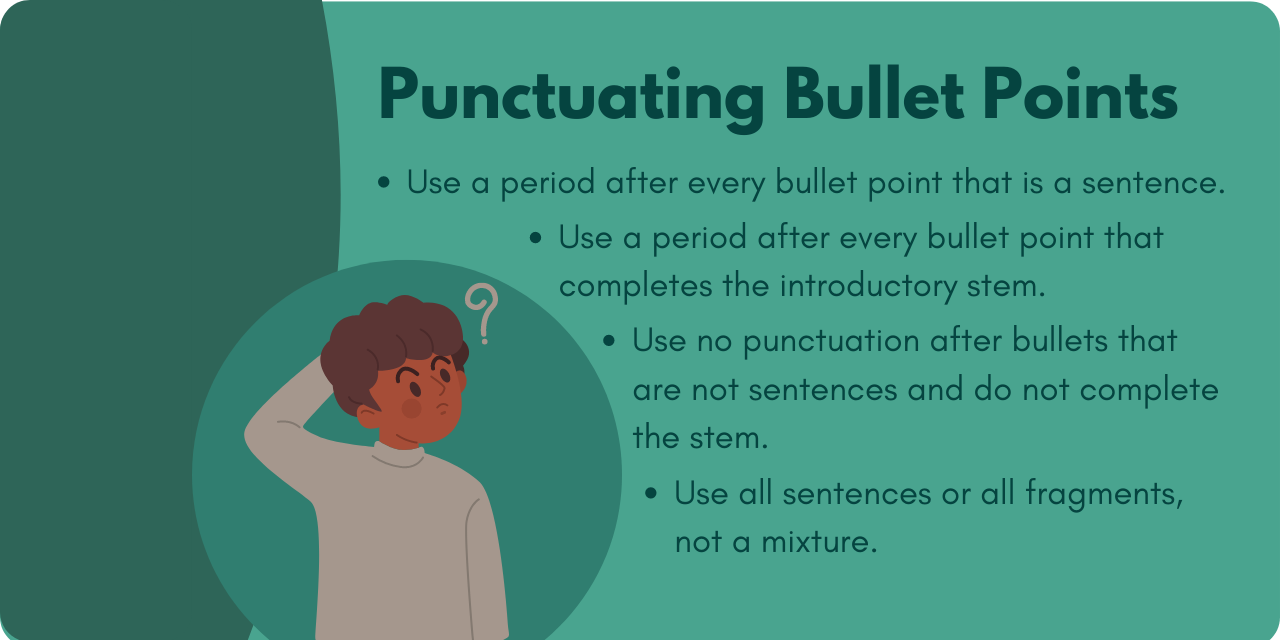
- Use a period (full stop) after every bullet point that is a sentence (as these bullets do).
- Use a period after every bullet point that completes the introductory stem.
- Use no punctuation after bullets that are not sentences and do not complete the stem.
- Use all sentences or all fragments, not a mixture.
Directly below is an example of bullet points that complete the introductory stem. Below that example is a version that does not need periods.
I like living in Seattle because of its:
- Access to culture, natural beauty, and work opportunities.
- Moderate climate–not too hot or too cold.
- Liberal politics and social attitudes.
Here are the things I like about living in Seattle:
- Access to culture, natural beauty, and work opportunities
- Moderate climate–not too hot or too cold
- Liberal politics and social attitudes
There is an exception to putting periods after bullet points that complete the stem sentence: If they are one word or a short phrase that feels like an inventory or shopping list, do not use end punctuation. Below is an example:
I like living in Seattle because of its:
- Culture
- Natural beauty
- Work opportunities
- Moderate climate
- Liberal politics
- Social openness
I generally follow The Gregg Reference Manual’s rules on punctuating bullets. However, Gregg also uses periods after bullets that are dependent clauses and long phrases.
Garner’s Modern American Usage, a reference manual I respect and use, also inserts periods at the end of bullet points–if they begin with a capital letter. However, Garner notes:
“If you begin each item with a lowercase letter, put a semicolon at the end of each item, use and after the next-to-last item, and put a period after the last item.”
The Chicago Manual of Style has pages of rules and examples of bullet points, but it agrees with the Garner style quoted above, calling the style “vertical lists punctuated as a sentence.” Here is my example of that style:
It is my responsibility to [Garner uses a colon here but Chicago does not]
- provide participant prework questions for your roster of attendees;
- review participants’ responses and writing samples; and
- customize the workshop to match individuals’ and the group’s needs.
To me, the style above is too fussy for business writing. It doesn’t look crisp or energetic. There is also the question of introducing bullet points, and we have a piece dedicated to the topic.
For more about those efficient chunks of text we use so often, read my post “Best Practices for Bullet Points.”