Pam wrote to me to settle a debate between the younger and the older employees in her office. Her brief question was this:
4pm or 4:00pm?
My answer: Neither!
Both of Pam's renderings are incorrect. She needs to insert periods and a space before the abbreviation, like this:
4 p.m. or 4:00 p.m.
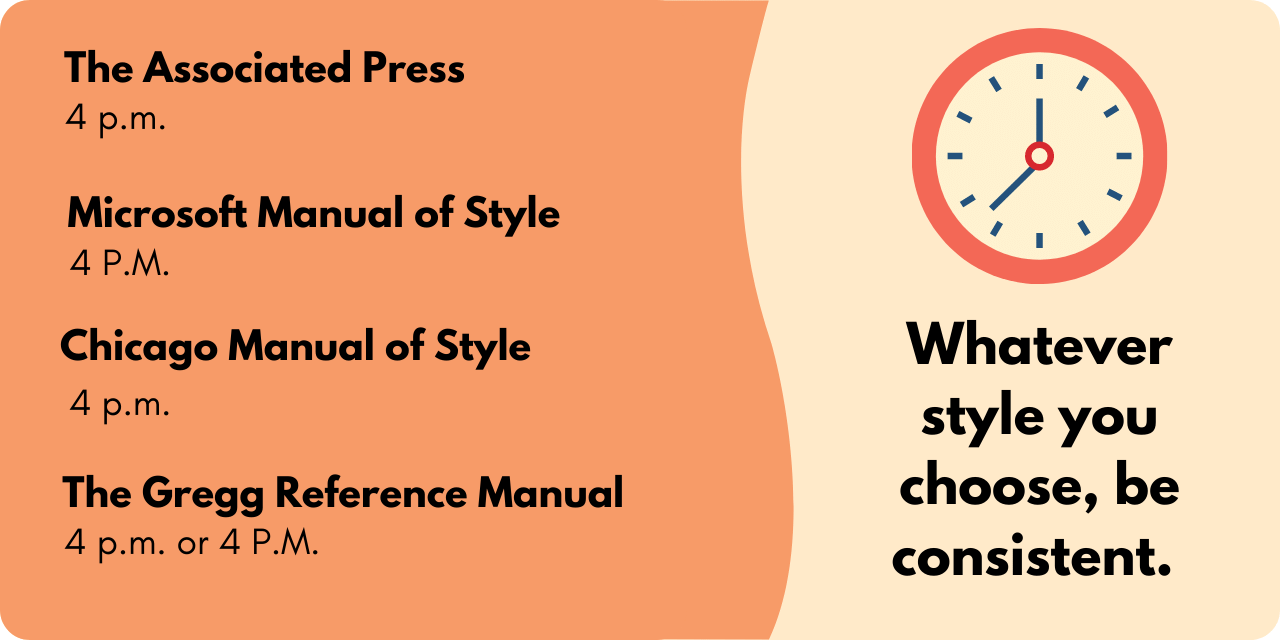
In email, many people seem to be dropping both the periods and the space, but don't follow the crowd. The prominent style guides do not support that choice. Here is a sampling of recommendations:
The Associated Press Stylebook:
4 p.m.Microsoft Manual of Style for Technical Publications:
4 P.M.The Chicago Manual of Style and Garner's Modern American Usage:
4 p.m. or 4 PM (with PM in small capitals)The Gregg Reference Manual:
4 p.m. or 4 P.M. (with PM in small capitals)
Whatever style you choose, be consistent. I always use lowercase letters: 4 p.m.
Pam's coworkers were apparently arguing about whether to include the zeros. Omit zeros when the time is on the hour, but include them in a list of varying times like this one:
7:00 a.m. Registration
7:30 a.m. Breakfast
8:00 a.m. Announcements
8:15 a.m. Speaker
Pam, it's time for you and your coworkers to pitch in and get a style manual. See the recommendations on my website.
Does your style guide recommend a different approach to time? If so, please share it here.
Lynn
Syntax Training


Great, never thought about it before. Thank you!
Posted by: Srikanth | June 06, 2009 at 04:47 AM
I prefer use the 24 hr clock for schedulling, it´s a good option and it´s easier avoid misunderstadings for the people whom just pass a eye in the schedule.
Why dou you think Lynn?
Kind Regards
Conrado
Posted by: Conrado Calvet | June 08, 2009 at 06:40 AM
I think the 24-hour clock is an excellent idea. I find, though, that many people in the United States prefer a.m. and p.m., particularly if their business does not run 24 hours a day.
Posted by: Lynn | June 08, 2009 at 05:01 PM
My style manual is the American Medical Association's Manual of Style, which avoids using punctuation in abbreviations (up to and including MD, eg, and ie). It's one of the hardest things for people to get used to when they start writing at my company. The other hard thing for people to remember is not spelling out numbers unless they start a sentence -- even numbers under 10! You can see a brief overview of AMA style here:
http://www.docstyles.com/archive/amastat.pdf
Posted by: Lisa | June 22, 2009 at 02:09 PM
Lisa, thanks so much for sharing the information and a resource. It is helpful to know about the differences.
I can understand how new employees struggle with the punctuation and number rules. I am glad you have a style sheet to support the new writers--and the rules.
Posted by: Lynn | June 26, 2009 at 10:20 AM
What about a period of time? If a function runs from 5 p.m. - 7 p.m. Or is it 5 - 7 p.m.?
Posted by: Sue | March 04, 2010 at 01:16 PM
Actually, in a business context, it is best to ALWAYS use zeros (4:00). Though this rule can "bend" for native speakers, if you are working with internationals, it's better to have a consistent rule that is applied at all times.
Also, when using the 24-hour clock (a norm for those outside North America), you should use a leading zero to avoid confusion (04:00 rather than 4:00).
Finally, it's important to avoid being draconian when writing emails. A new register has actually been created for emails: neutral. So there is formal for letters and legal/offical matters, informal for person correspondence and neutral for business email correspondence.
Posted by: John | April 28, 2010 at 04:49 AM
What about if the 4 P.M. is at the end of the sentence? Do you need to put another period?
Posted by: dyhlon | April 29, 2010 at 06:07 PM
Sue, one mention of "p.m." is sufficient when your meaning is obvious.
John, thank you for mentioning international audiences and their needs.
Dyhlon, you need only one period at the end of the sentence. Two periods would be incorrect.
Lynn
Posted by: Lynn Gaertner-Johnston | May 01, 2010 at 10:38 AM
I also write AM and PM without the periods or the spaces. I always thought that writing A.M. or a.m. or P.M. or p.m. was not the correct way of writing that. I guess I am an old stick in the mud, and since I hate change, or newer ways of doing things, I am going to stick with writing AM and PM. It might be wrong, or grammatically incorrect, but it is what I am used to.
Posted by: Christine Clinton | February 10, 2011 at 07:59 PM
Christine, you are not an old stick-in-the-mud. You are on the cutting edge! Only some style manuals have begun to leave out the periods in question. My "Handbook of Business English," first published in 1914, includes them.
You didn't know how modern you are.
Lynn
Posted by: Lynn Gaertner-Johnston | February 11, 2011 at 10:08 AM
Is it proper to write: At 4p.m. this afternoon we will be meeting. . .
Is it improper to add the word 'afternoon' if you have stated that the time is 4 p.m.?
Posted by: Ben | June 15, 2011 at 03:09 PM
Hi, Ben. It is redundant to write "4 p.m. in the afternoon." However, "4 p.m. this afternoon" does clarify which afternoon (for example, not tomorrow afternoon).
A better choice is "4 p.m. today."
Lynn
Posted by: Lynn Gaertner-Johnston | June 15, 2011 at 10:39 PM
Any answer to:
"What about a period of time? If a function runs from 5 p.m. - 7 p.m. Or is it 5 - 7 p.m.?"
Posted by: Mister Nice Guy | July 11, 2011 at 07:43 AM
Hi, Mister Nice Guy. I belatedly answered Sue's question on May 1, 2010:
One mention of "p.m." is sufficient when your meaning is obvious.
Lynn
Posted by: Lynn Gaertner-Johnston | July 11, 2011 at 01:08 PM
What is the correct way to write 12 midnight or 12 noon
Is the 12 noon, 12:00p.m. or 12:00 a.m.?
Posted by: Sally Kelly | July 11, 2011 at 08:13 PM
Sally, many reference books recommmend simply "midnight" or "noon." However, if you are entering that time with a list of other times, use "12 midnight" or "12 noon." Using the number alone with a.m. or p.m. can be confusing in some contexts, so avoid that approach.
Lynn
Posted by: Lynn Gaertner-Johnston | July 15, 2011 at 09:57 AM
Hi Lynn,
I've been searching online for the proper way to list an event day, date and time and came across this blog post. Perhaps you can help? Is the following the correct way:
XYZ panel takes place on Tuesday, September 13, at 11:00 a.m.
Thanks in advance for any clarification!
Posted by: Mircalla | September 09, 2011 at 10:21 AM
Hi, Mircalla. Your sentence looks fine. You would also be correct to write "11 a.m." (without the zeros), especially if you have no other times to list.
Lynn
Posted by: Lynn Gaertner-Johnston | September 09, 2011 at 11:58 AM
Did you notice the time stamps here - capital letters, no punctuation. Now what?
Posted by: John Snakenborg | October 12, 2011 at 09:19 AM
Hi, John. Interesting question! It appears that TypePad, the host for this blog, follows the style of "The Chicago Manual of Style" and "Garner's Modern American Usage" (see above), more or less.
Posted by: Lynn Gaertner-Johnston | October 12, 2011 at 11:30 AM
Dear Lynn,
How would I write a time when asking a question?
Example: Are you available at 4p.m.?
Would I have the periods between the "p" and the "m" and then put the question mark?
Posted by: Pa | December 19, 2011 at 07:19 AM
Your example is almost correct. You need a space between the 4 and the p, like this:
Are you available at 4 p.m.?
Lynn
Posted by: Lynn Gaertner-Johnston | December 19, 2011 at 01:28 PM
Hi Lynn!
How would time zone abbreviations fit into this equation?
Thanks!
Posted by: Todd | January 06, 2012 at 06:29 AM
Hi, Todd. Search for my post "It's About Time: Clock Time" in the search box at upper right.
Lynn
Posted by: Lynn Gaertner-Johnston | January 06, 2012 at 12:14 PM
Thanks!
Posted by: Todd | January 06, 2012 at 01:57 PM
May I say 12:30 noon
Posted by: Nina | April 17, 2012 at 05:29 AM
Hi, Nina. No, "12:30 noon" is never correct. Noon can only be 12 o'clock--not 12:30.
Lynn
Posted by: Lynn Gaertner-Johnston | April 17, 2012 at 11:48 AM
How do you handle time zones? i.e. 4:00 p.m. CT
Posted by: Steve | May 15, 2012 at 06:07 AM
Hi, Steve. I prefer to spell out time zones so readers will recognize them. Read more here:
http://www.businesswritingblog.com/business_writing/2006/05/its_about_time_.html
Lynn
Posted by: Lynn Gaertner-Johnston | May 16, 2012 at 02:43 PM
I question the requirement of spaces before the am/pm, for modern practicality uses. Not everyone knows how to use non-breaking spaces, and if that isn’t used, then, particularly on websites and in Email where one cannot guarantee the same fonts, browser width (especially relevnt for fluid layouts, which are coming back into style due to smartphones), etc., the possibility exists of word-wrap causing the time to appear at the end of a line, and the am/pm at the beginning of the next line, like so:
“The fun starts at 7
p.m. and lasts until
midnight!”
This cannot happen if you use, for instance, “7pm”.
Of course, the best solution is to just learn to use non-breaking spaces as needed.
Posted by: Joel | July 05, 2012 at 11:49 AM
Joel, you make an excellent point. I will be interested to see if the writing style guides catch up with your idea.
Thanks for taking the time to share your view.
Lynn
Posted by: Lynn Gaertner-Johnston | July 05, 2012 at 07:57 PM
a.m. and p.m. creates doubt in some contries. i suggest it will be better to use 24 hours clock time.so no doubt is there isn`t it?
Posted by: Arvind Parekh | October 02, 2012 at 03:15 AM
Hello, Arvind. I agree that companies who write to people around the globe should consider using the 24-hour clock.
Thanks for commenting.
Lynn
Posted by: Lynn Gaertner-Johnston | October 02, 2012 at 09:24 AM
If you are writing the time range 11:00 a.m. - 1:00 p.m., do you have to include the a.m., or is it okay to write 11:00-1:00 p.m.?
Posted by: Patty Giovingo | October 23, 2012 at 08:16 AM
Hello, Patty. It is not acceptable to use p.m. without a.m., as your example does. It would be too confusing for readers.
Lynn
Posted by: Lynn Gaertner-Johnston | October 24, 2012 at 09:49 AM
I can't find much support for my way of thinking, but using lowercase letters and periods just looks "old school" to me. I've worked as a tech writer for more than 30 years (much of it in IT), and it just looks cleaner to omit the periods.
"The upgrade is scheduled for 7:00 am tomorrow."
"The upgrade is scheduled for 7:00 pm tomorrow."
I agree that when used in a sentence, the morning designation without periods COULD be read as the word "am," and yet I don't worry about this since the context is clear.
That's my opinion, and I'm stickin' to it! :-)
Posted by: Kathy | October 26, 2012 at 07:09 AM
Hi, Kathy. You are correct that reference manuals don't agree with you, not even "Microsoft Manual of Style," which was published this year.
I felt the same way about the word "gray." I wanted to spell it "grey," the British way, because it looked right to me. But living and working in the US, I decided to give up my preference and use "gray."
Good luck with your choice.
Lynn
Posted by: Lynn Gaertner-Johnston | October 26, 2012 at 04:03 PM
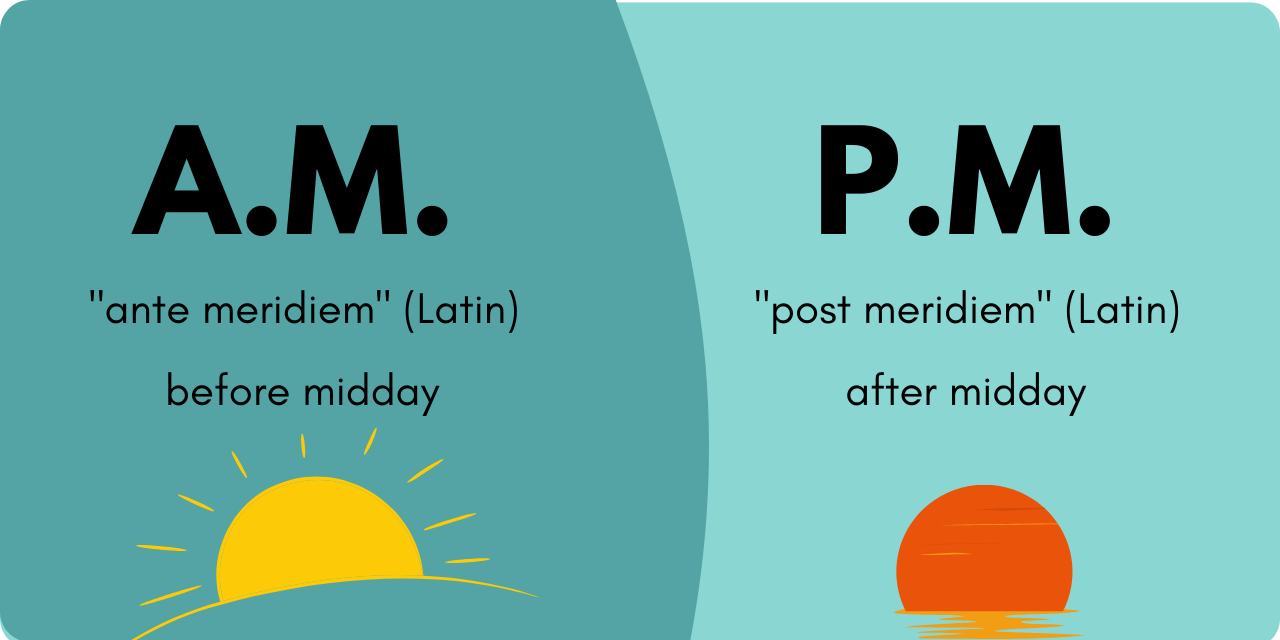
You would think finding this information would be relatively simple, straight-forward and easy, given the amount of technology at our fingertips. However, I've been searching for nearly 15 minutes on this, which is really too much time, and I'm still frustrated. I have the St. Martin's Guide to Library and Research Documenting, which lists AMA, APA, CBE, and Note-and-Bibliography styles for just about everything, but it also lists abbreviations for time, acronyms, geographical names, and a few other things that are shared amongst all styles. The proper format for time is lower case with periods. It also explains that a.m. is ante meridiem, "before noon" and p.m. is post meridiem, "after noon". This makes sense as to why the periods are necessary, though I don't know how consistent it is across all Latin translations like that. For example, "for example" (<--haha!) we use "e.g.", but for "and others" we use "et al." and not "et. al."
Anyway, I'm going to go with lower case and periods even though it's a pain. And as for gray/grey- I realize that after I read that, I actually search it every time I write it because I'm never sure. I'm not even sure if I search grey or gray, but since both ways are correct, whichever one I search comes up so I use it and assume it's right. That is probably the reason I never know which is right because they are both right! (I have no idea if that last part made sense or not.) :)
Posted by: AC | November 05, 2012 at 06:56 AM
Hello, AC. Life is full of complexity, isn't it?
I am happy to tell you that the "et" in "et al." has no period because it is not an abbreviation. The phrase when spelled out is "et alia."
Regarding "grey" and "gray," "gray" is preferred in the United States. I am not certain which is preferred in other countries.
Thank you for stopping by.
Lynn
Posted by: Lynn Gaertner-Johnston | November 05, 2012 at 10:16 AM
Hi Lynn,
What is the correct order/style when you write a sentence which contains following parts: time, day, month, year, day of the week? What is the correct order of those parts? Thanks!
zky
Posted by: zky | November 14, 2012 at 07:05 PM
Zky, here is an example to answer your question:
I will see you on Wednesday, November 28, 2012, at 11 a.m.
OR
I will see you at 11 a.m. on Wednesday,
November 28, 2012.
You do not need to include the year if it is obvious and you are not writing a legal document. In both examples above, you would simply delete the year.
Lynn
Posted by: Lynn Gaertner-Johnston | November 16, 2012 at 10:32 AM
Lynn,
Thank you for this great post! My only question is how do I use proper punctuation with the examples shown. If a sentence ends with the time, do I need to insert a period after the "p.m."?
For example: I have to meet Cathy at 2 p.m.
I assume in this sentence, I would not insert a period after the time because that would look silly (2 p.m..).
However, if I write this same sentence as a question, I would obviously insert a question mark.
Do I have to meet Cathy at 2 p.m.?
Could you please clarify the rule on punctuation when the time is written at the end of a sentence?
Jared
Posted by: Jared | December 06, 2012 at 08:20 AM
Hi, Jared. Both of your examples are correct. The period is not doubled in a declarative sentence, but the period does appear before a question mark.
Lynn
Posted by: Lynn Gaertner-Johnston | December 06, 2012 at 09:22 AM
What is correct?
4:00 p.m.
4:00 PM
4:00p.m.
4:00PM
Posted by: Marfaret Collins | December 29, 2012 at 11:03 AM
Marfaret, according to the reference guides I cited above, only 4:00 p.m. is correct.
Lynn
Posted by: Lynn Gaertner-Johnston | December 30, 2012 at 09:46 AM
The first comment to this post, posted on June 06, 2009 at 04:47 AM, and the most recent, December 30, 2012 at 09:46 AM.
Ironically, for over three years the time format for this blog has been: Month Day, Year at 00:00 AM or Month Day, Year at 00:00 PM.
It seems the only .s being used these days are at the end of sentences. My child, at times, avoids them there as well. :) or :(
Posted by: Randy Mintken | April 30, 2013 at 10:08 PM
Hi, Randy. Woe is us! (Woe is WE?)
When I get frustrated over a lack of punctuation, I try to remember that I can control only my own behavior, not that of others.
Good luck with your child!
Lynn
Posted by: Lynn Gaertner-Johnston | May 04, 2013 at 09:09 AM