
Recently, a question from one of our readers regarding our Business Writing Tune-Up class came up: in a hyphenated compound word, shouldn’t a little word like up be lower case?
As is often the case with capitalization, it depends what part of speech up is. In tune-up, up is an adverb (not a preposition such as in “up the street”).
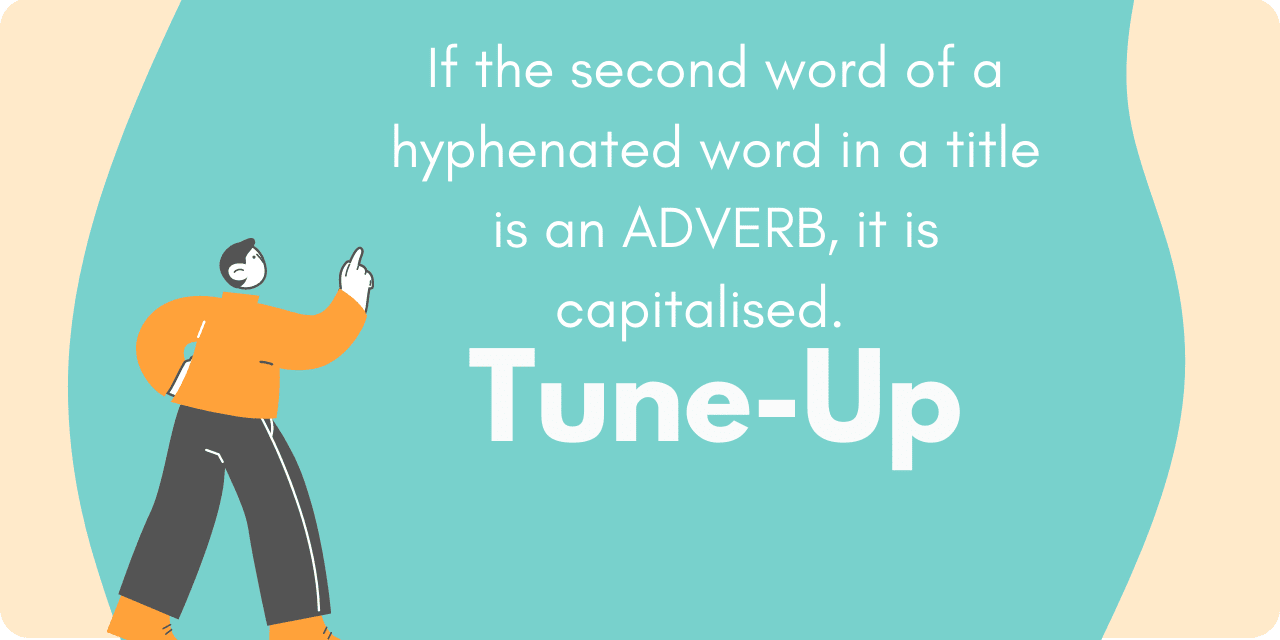
Adverbs are capitalized in titles — even when they are the last part of a hyphenated compound. The four reference books on our shelves all agree about adverbs: The Chicago Manual of Style, Microsoft Manual of Style, The Gregg Reference Manual, and Garner’s Modern English Usage. (The Associated Press Stylebook only says to capitalize “principal words”–it offers no additional details to cover adverbs.)
Chicago, Microsoft, and Gregg specifically address hyphenated compounds.
The Chicago Manual of Style has simplified its capitalization rules in its most recent (17th) edition. For hyphenated compounds, it recommends:
- Always capitalize the first element.
- Capitalize any subsequent elements unless they are articles, prepositions, coordinating conjunctions (and, but, for, or, nor), or such modifiers as flat or sharp following musical key symbols. [Chicago used to consider whether parts of a hyphenated word were stressed or unstressed to determine capitalization.]
- If the first element is merely a prefix or combining form that could not stand by itself as a word (anti, pre, etc.), do not capitalize the second element unless it is a proper noun or proper adjective. [Chicago gives as an example Anti-intellectual Pursuits.]
- Capitalize the second element in a hyphenated spelled-out number (twenty-one or twenty-first, etc.) or hyphenated simple fractions (two-thirds in two-thirds majority). [Chicago used to render the second elements lower case.]
Microsoft Manual of Style and The Gregg Reference Manual agree with Chicago–with these exceptions:
- Chicago capitalizes no prepositions of any length except when “they are used adverbially or adjectivally” or when “they compose part of a Latin expression used adjectivally or adverbially.” Microsoft capitalizes prepositions that are five or more letters. Gregg capitalizes prepositions (and conjunctions) of four or more letters.
- Microsoft and Gregg do not follow Rule 3 above. They would both capitalize all words in Anti-Intellectual Pursuits.
- Microsoft and Gregg would capitalize flat and sharp if they appeared in a title (unlike Rule 2).
Beyond that, all three capitalize the first and last word of a title.
Considering those rules, these hyphenated words would all be correctly capitalized in titles:
Follow-Up
Runner-Up
Close-Up
Start-Up
Shoo-In
Run-In
Trade-In
Walk-In
Turn-On
Take-Off
Write-Off
Phase-Out
In the list above, up, in, on, off, and out are adverbs–not prepositions. That’s why they are capitalized. (Note: If they were prepositions, they would lead to a noun or a pronoun, as in “A Song in My Head” or “I Heard It on the Radio.”)
Also following the rules above, these examples would all be capitalized in titles:
Twenty-First-Century
Two-Thirds Majority
Non-English-Speaking
Self-Sustaining
Record-Breaking
Run-Time
Upper-Class
Speaking of Upper-Class, how would you capitalize well-to-do?
We’ve illustrated our decision in this made-up title: “Well-to-Do Not Doing So Well.” Chicago guided me with its rule: “Lowercase to not only as a preposition but also as part of an infinitive (to Run, to Hide, etc.).”
If you had not already recognized the value of a style sheet, these examples make a strong case for creating one. No more stressing over which hyphenated words should be capitalized in a title! Just stress once, decide, and record your decision.